


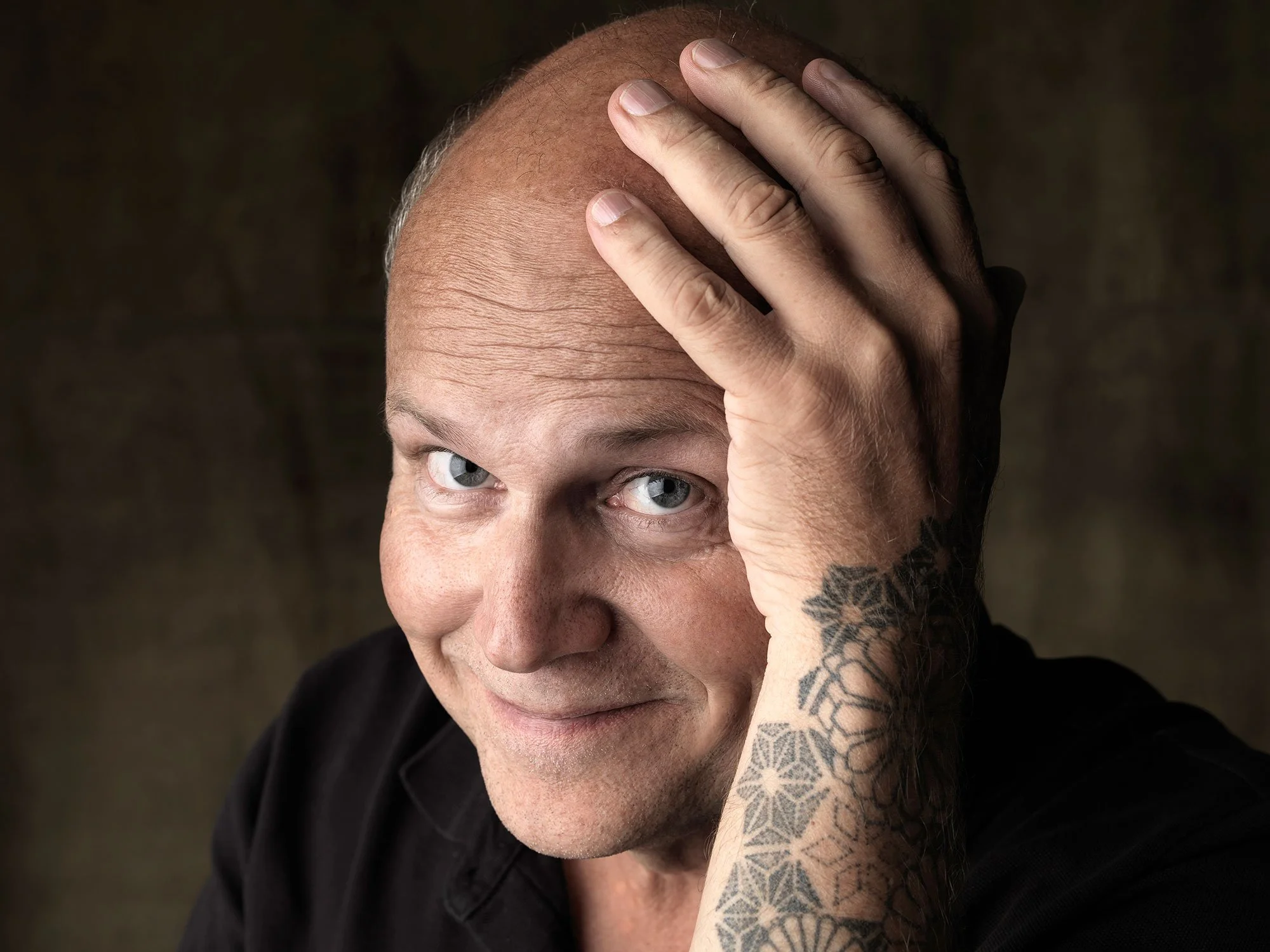
“Designers deserve a revolution: confidence in their value, social recognition and the means to thrive. That's why we're creating Copryce."
Why Copryce
To Zoé, Violette and Mila, my creative and talented daughters.
I was born in 1967 into a family where art was everywhere and money was taboo. From an innovative landscape architect grandfather close to the Parisian avant-garde of the 1950s-60s, I inherited a rootedness in trees and undoubtedly a taste for major innovative projects. From a teacher and abstract painter father: the trace, spatiality. From a teacher and figurative painter mother: the pictorial sense of Polish poster masters, the humor of illustration from Tomy Ungerer to Roland Topor, initiation to film photography, darkroom and printing. We moved often with my parents, following their teaching positions, all the way to Algeria and Canada. I learned early about adaptation and openness to the world.
As a student, I observed something troubling: my artist parents had teaching as their profession, notions of the art market were foreign to them, yet creating was essential to them. A tension between the search for recognition and economics would become one of the guiding threads of my professional existence.
In 1989—the year of the bicentennial of the French Revolution—I chose a provocative subject for my communication design master’s thesis: Art & Money. Talking about it in art schools was almost obscene, and still is today. The confusion was blatant: many thought that market value automatically equated to artistic value, or vice versa. Yet it’s supply and demand that makes a market work, not talent alone.
That year, Van Gogh’s Irises exceeded hundreds of millions of dollars at auction. Yet Van Gogh had sold nothing during his lifetime. His death in 1890 paradoxically marks the beginning of the modern art market and collectors. I organized a debate in my school in Orléans, bringing together players in this market: a gallery director (Maeght) who was an art historian and critic, an auctioneer specializing in the 19th and 20th centuries, a banker investing in art, a sculptor who loved bricks. This debate confirmed an intuition: creators needed to understand the economic mechanisms of their own sector to thrive.
Building where no one expects us
In 1990, after six months of business management training, I created Zinzoline with my friend Vincent Burille, my first visual communication company in Orléans. Starting a design activity in "the provinces," where at the time very little design culture circulated in businesses, was a challenge. We were pioneers, our difference from our competitors brought us success. We designed the visual communication for local and larger communities and companies. It was a very formative experience.
My first works included commissions on human rights. A decade later, I was traveling abroad to teach poster art: Mexico, United States, China. I was meeting my masters, colleagues with whom to exchange about our profession and its conditions. In Europe, particularly in Germany and Scandinavian countries, I discovered how designers organized themselves into serious, multidisciplinary, effective professional associations.
In the 2000s in France, nearly twenty associations were barely surviving, undermined by territorial wars. Each discipline defended its own turf. This fragmentation weakened us all.
I then wanted to contribute to creating the French equivalent of models seen elsewhere in Europe: an open and inclusive organization, capable of giving the design profession true visibility and weight in the political and economic decisions that determine our working conditions.
The poster as universal language
Parallel to my commercial communication activity, I developed a personal practice of poster art. For me, the poster is not simply a visual medium. It’s a linguistic research tool with multiple levels of sophistication. A universal language that transcends borders and languages. My R&D, so to speak.
My influences were multiple. From Cassandre, I learned rigorous image construction. From Raymond Savignac, the importance of humor and simplicity. From Germans John Heartfield and Raoul Hausmann, I discovered photomontage as a political weapon. From Poles Henryk Tomaszewski and Roman Cieslewicz, I retained the poetic approach and engagement with current events. From Japanese Shigeo Fukuda, the quest for absolute simplicity.
I had the extraordinary chance to meet two of my heroes: Roman Cieslewicz and Shigeo Fukuda. These encounters changed my life. They showed me that great masters teach much more than the art of design: they teach ethical values, a worldview, a commitment to society.
These posters on human rights, on great humanitarian causes, on social issues, became my passport to the world. They opened doors for me in forty countries. They were presented in nearly three hundred international exhibitions. They joined the collections of the Bibliothèque nationale de France, the Musée des Arts décoratifs in Paris, the Signe in Chaumont. They were published in magazines like Art and Design in China, Domus in Italy, Étapes in France, Experimenta in Spain, Idea in Japan.
But above all, they allowed me to weave an international network of colleagues with whom to share our common concerns: Mirko Ilić and Cedomir Kostović from Bosnia, Andrew Lewis from Canada, René Azcuy from Cuba, Neville Brody from England, Pekka Loiri and Kari Piippo from Finland, Holger Matthies from Germany, Massimo Vignelli from Italy, Mieczyslaw Wasilewski from Poland, Milton Glaser and Paula Scher from the United States, and so many others.
These exchanges taught me something fundamental: we all shared the same professional difficulties, the same ethical questions, the same aspirations. A Polish designer encountered exactly the same obstacles as a French designer facing a client who didn’t respect copyright. An American designer asked the same questions as an Italian designer about fair compensation for their work.
Everything is connected: unity between creation and organization
There’s a tendency to separate artistic practice, design creativity, from organization and the seriousness of economic questions. As if the artist and the entrepreneur were two distinct, even contradictory personalities. As if creativity opposed pragmatism. As if engagement in a professional union were incompatible with aesthetic research.
I don’t believe in this separation. My story shows the opposite. Everything is connected.
My poster practice taught me the rigor of visual construction. This same rigor helped me structure Alliance France Design. The empathy I developed creating posters for great humanitarian causes nourished my commitment to improving the living conditions of my colleagues. The international networks I wove through my exhibitions allowed me to import the best European professional practices to France. The ethical values transmitted to me by my masters are found in every charter, every code of ethics, every innovation we’ve carried collectively.
Brigitte Borja de Mozota, who accompanies me in the Copryce adventure, demonstrated something essential that largely influenced (notably) Tim Brown, the president of IDEO: design is not only the production of tangible objects and spaces or final images. Design is a process, a science of organization. It’s a way of thinking, structuring, solving complex problems—that famous design thinking. When I create a poster, I solve a visual communication problem. When we structure a designers’ union, we solve a collective organization problem. When we design the Calkulator, we solve an information and economic decision problem. In all three cases, we apply the same skills: analyze, synthesize, visualize, organize.
This vision of design as a science of organization explains why I’ve never experienced contradiction between my different activities. The artist, the entrepreneur, the activist, the educator: these aren’t four different people. It’s one designer applying their methodology to different issues. Creating a poster that will make people think about human rights and creating a tool that will help designers better negotiate their fees is the same intellectual gesture. In both cases, I seek to make the invisible visible, to give form to what doesn’t yet exist, to organize information in a way that enables action.
This empathy for my peers wasn’t a moral posture, it was an awareness that we needed to organize collectively. My artistic practice of poster art and my professional engagement didn’t oppose each other, they complemented each other. One nourished the other. My posters gave me international artistic legitimacy. This legitimacy allowed me to carry the voice of French designers in Europe. And my union action was meant to concretely improve my working conditions and those of all my colleagues, allowing us to devote ourselves more to our creation.
When one world collapses, another can be born
In December 2001, the Syndicat national des graphistes, after sixty-seven years of existence, filed for bankruptcy. I was vice-president alongside Christian Dao, the president, and François Weil, the treasurer. This collapse could have been experienced as a failure. We experienced it as an opportunity.
The year 2002 was a year of intense reflection. We debated the modalities of creating a new organization. In December 2002, with Arnaud Corbin, Christian Dao, Véronique Marrier, Caroline Naillet and François Weil, we founded the Alliance française des designers. The statutes were registered in the Journal officiel on January 9, 2003.
Our vision was clear: to create a multidisciplinary union that would defend the economic and cultural interests of all French designers, regardless of their discipline, legal form or mode of practice. From 2003 to 2017, we succeeded in what no one had done before us: merging the five main designers’ unions in France. The Syndicat des designers d’environnement in 2003, the Union française des designers industriels in 2004, the Syndicat national des designers textile in 2009, the Fédération des designers industriels in 2017.
In 2018, the Alliance française des designers became Alliance France Design. A shorter, more inclusive name, understandable in all European languages. Three words to say: we are together, we are French and European, we are design.
Building the profession’s tools collectively
I did nothing alone. Every advance was the fruit of collective work, shared intelligence, crossed commitments.
In 2008, with the help of the Alliance of German Designers, Design Luxembourg and the Union des Designers in Belgium, we launched the Calkulator, a European pricing guide that has served more than eleven thousand designers in seventeen years.
In 2012, with Béatrice Gisclard, former president of Alliance France Design, we designed and co-wrote the first Code of Ethics for professional designers in France, recognized by the International Council of Design and the World Design Organization.
In 2013, with Marie-Noëlle Bayard, we obtained access to continuing professional training for designers under the authors' regime, allowing them to adapt their skills to the new needs of their activity.
With successive teams at Alliance, we developed guides to good design commissioning practices, contract templates. A collective approach where I could play the role of locomotive, but never solitary conductor.
Since 2003, with the help of lawyers François Lesaffre and Coralline Manier, I've provided legal assistance for Alliance. More than five hundred cases handled, more than two thousand hours of analysis, ten mediations, twenty-four legal actions followed. Each case taught me something about the real difficulties designers face with their clients, with contracts, with money. These hundreds of individual stories nourished our collective reflection on necessary structural changes.
The missing link
A few years after the launch of the Calkulator, at a seminar in London, I met Canadian Blair Enns. It was a culture shock. Blair comes from commerce, from marketing. A consultant for creative businesses, he knows designers well, whom he calls “The People Who See.” He understands what motivates us and what holds us back.
Blair proposed a simple, clear, understandable method to move forward by overcoming our emotional blocks. He described with precision this habit of offering our ideas for free, this unhealthy need for recognition that pushes us to squander our most precious asset: our expertise.
I immediately wanted this knowledge to be shared with my French colleagues. I translated his manifesto, The Win Without Pitching Manifesto, under the title Gagner sans idées gratuites. I published and sold it as a complement to the Calkulator. Blair brought the missing link: the commercial strategy that I advocated from the angle of ethics and professional values, he approached from the angle of business and economic development. What I defended without offering a concrete method, he explained step by step. Then I organized seminars for him in Europe. We became friends.
Connecting the dots of my existence
Nicole, co-founder of the Cercle Jean Zay, had introduced me to Souvenirs et Solitude, the great book that Jean Zay wrote in prison before being assassinated by the French militia in June 1944. He was the initiator of the Cannes Film Festival, created in reaction to the fascism and nazism present at the Venice Mostra of 1938. But what few people know is that in his memoirs, Jean Zay planted the seeds of French copyright. It was his friend Pierre Mendès France who finally promulgated the laws on literary and artistic property of March 11, 1957. These laws are more fair and more recognizing toward artists, authors, cinema, than Anglo-Saxon copyright. This copyright has influenced the entire world. It’s still the economic model that sustains me today.
Living in Jean Zay’s city, I was deeply moved by the story of this visionary minister of the Popular Front, responsible for Education and Fine Arts. In 2019, with Pascal and Svetlana, under the scientific direction of film historian Antoine de Baecque, we organized in Orléans a cultural event particularly close to my heart: the reconstruction of the first edition of the Cannes International Film Festival 1939, the one canceled by the outbreak of World War II.
Defending Jean Zay’s memory by bringing back to life this first phantom edition of the Cannes Festival was to reconcile my convictions with my artistic and economic existence. The success was phenomenal: six days, thirty-two thousand entries. We had succeeded in honoring the legacy of a man who believed that culture could change the world and that creators should be justly compensated for their contribution.
What three decades have taught me
All my innovations are connected. They are concrete applications of this deep conviction: design is a science of organization that applies as much to visual creation as to structuring a profession.
The Code of Ethics that we created with Béatrice Gisclard gives benchmarks to design practitioners and their clients. Access to social security for authors repaired an injustice that excluded certain artistic design disciplines. The Charter for public design procurement allowed communities and designers to agree fairly when a certain anarchy reigned between 1990 and 2012. Alliance France Design imported business notions from elsewhere in Europe, its legal assistance finally offered an efficient service where existing organizations failed. The Calkulator helped designers professionalize.
However, during two decades with the Calkulator and legal assistance, I witnessed a disturbing truth: even the world’s best designers undervalue themselves. Sometimes systematically, methodically, painfully. I’ve seen brilliant creators give away their ideas for free, accept conditions that exhaust them, lose negotiations before they even begin, fight alone against a system that pushes them to undersell their expertise.
And I understood something fundamental: pricing also needs global vision, strategy and training. A fair price is useless if you don’t know how to defend it. A beautiful commercial proposal collapses without the words to negotiate it. Talent isn’t enough when you lack confidence facing a financial director who dissects your quote.
Copryce: the culmination of a lifetime of struggle
Today, I’m connecting the dots. We have the technology and artificial intelligence to improve the tool while taking into account the requests of Calkulator users. But Copryce is much more than a technical evolution. It’s the culmination of everything I’ve learned since 1989. It’s the application of this unified vision of design as a science of organization, in service of the economic valorization of creators.
Copryce brings together three complementary axes:
Copryce B2B, the pricing tool, direct heir to the Calkulator but augmented thanks to AI. It helps designers estimate their fees and their exploitation rights with independent market data covering ten design disciplines in one hundred twenty-one countries. A mobile application is in development to fit in designers’ hands and assist them during their client meetings.
Copryce Lab, the resource and community space where we build design collective intelligence together. Videos, interviews, articles, feedback. A place where designers, entrepreneurs, teachers and institutions share their knowledge.
Copryce Training, the upcoming professional training component. Because negotiation is learned. Because business management is acquired. Because the best creators shouldn’t have to choose between their art and their economic viability.
I’ve devoted my life to demonstrating that creation and money should complement each other, to contributing to the tools, structures, networks that allow designers to thrive without denying their creativity. Copryce is the culmination of this journey. Not its end, but its acceleration. With the conviction that everything is connected: creation, economy, art, business, beauty, viability, individual, collective.
Designers deserve a revolution: confidence in their value, social recognition and the means to thrive. That's why we're creating Copryce.
François Caspar, December 2025
Photo © Christian Chamourat
Why Copryce® · Team · Pioneers · Contact-us · Legal notices · Terms of use · Privacy policy · AI use