

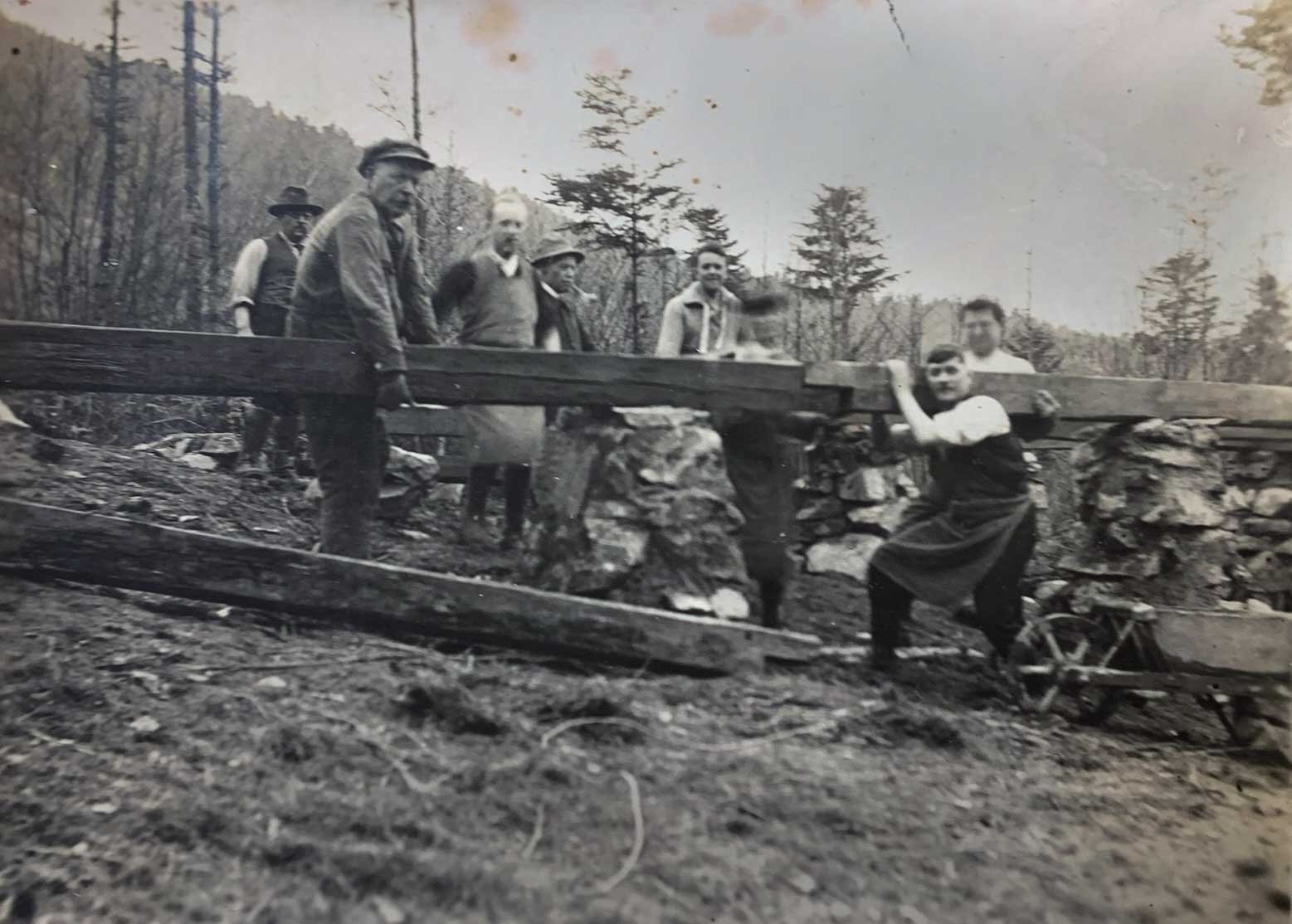
April 1928: twelve Alsatian painters build a chalet in the Vosges mountains. Ninety-seven years later, that story finances Copryce®. Here is how four generations of pioneers built to last.
Pioneers
From Bachmatten to Copryce®
1928, investing in something that doesn't exist yet
22 February 1928. Strasbourg. Twelve Alsatian painters sign the articles of association of the "Section touristique du Cercle des Amateurs d'Art". Among them: Charles Caspar, my great-grandfather, 42 years old, watercolour painter. Their plan: buy a prefabricated hut in Muhlbach (Haut-Rhin), transport it to the Vosges mountains and reassemble it in Bachmatten as a retreat for weekend painting.
The investment: 1,000 francs per member. For these railway workers, civil servants and teachers, that amounts to several months' salary. A considerable sum for a project that doesn't yet exist.
On 12 March they dismantle the hut. On 31 March, the boards and laths are delivered. From 6 to 14 April 1928, they build alongside master carpenter Aloyse Frei from Lutzelhouse. In the archive photographs, the painters are seen "lending a serious hand": digging foundations, shaping stones found on site, assembling walls. Total cost: 6,348 francs. The first chalet stands.
1928, before the European collective studios
Ten years after the end of the First World War, the twelve painters carry its trauma. Charles Caspar lost his left arm in combat. Their choice to build a mountain retreat is not incidental: it's a response to the violence they lived through, a need to build collectively and create in open nature.
And here is what makes this story remarkable: they grasped the strength of collective action and anticipated the artistic movements that followed the Second World War. Before the collective studios of European artists, before the communes of the 1960s. No modern comfort, no running water, no electricity until 1954, oil lamps, outdoor toilets. But direct access to the Vosges landscapes and time to paint. That's what it means to be a pioneer: to build before the world validates the idea.
Nine years later, the first chalet has become too small. In 1937, a second chalet is built. Larger, sturdier. Cost: 18,000 francs. The same founding members invest again. The model works — you build in order to grow.
1928–2026, four generations at the easel
Charles Caspar (1886–1957) builds the site and serves as its secretary from 1947 to 1957. He paints for 40 years with his right arm, having lost the left one during the war of 1914–18.
Charles-Marie Caspar (1915–1990), his son, paints there his entire life. He fights in the French army during the Second World War, while his father had fought in the German army during the First. The same ground for creation, despite the history that sets them apart.
Daniel Charles Caspar (1944–), teacher of visual arts and art history, painter himself, paints there and maintains the site. At 72, he writes a book documenting the complete history: Le Cercle des Amateurs d'Art de Bachmatten – Une école alsacienne du paysage, un héritage.
François Caspar (1967–) spends his childhood summers there, watching his grandfather at his easel, whistling the theme from The Bridge on the River Kwai, and his father turning bucolic landscapes into lyrical abstraction.
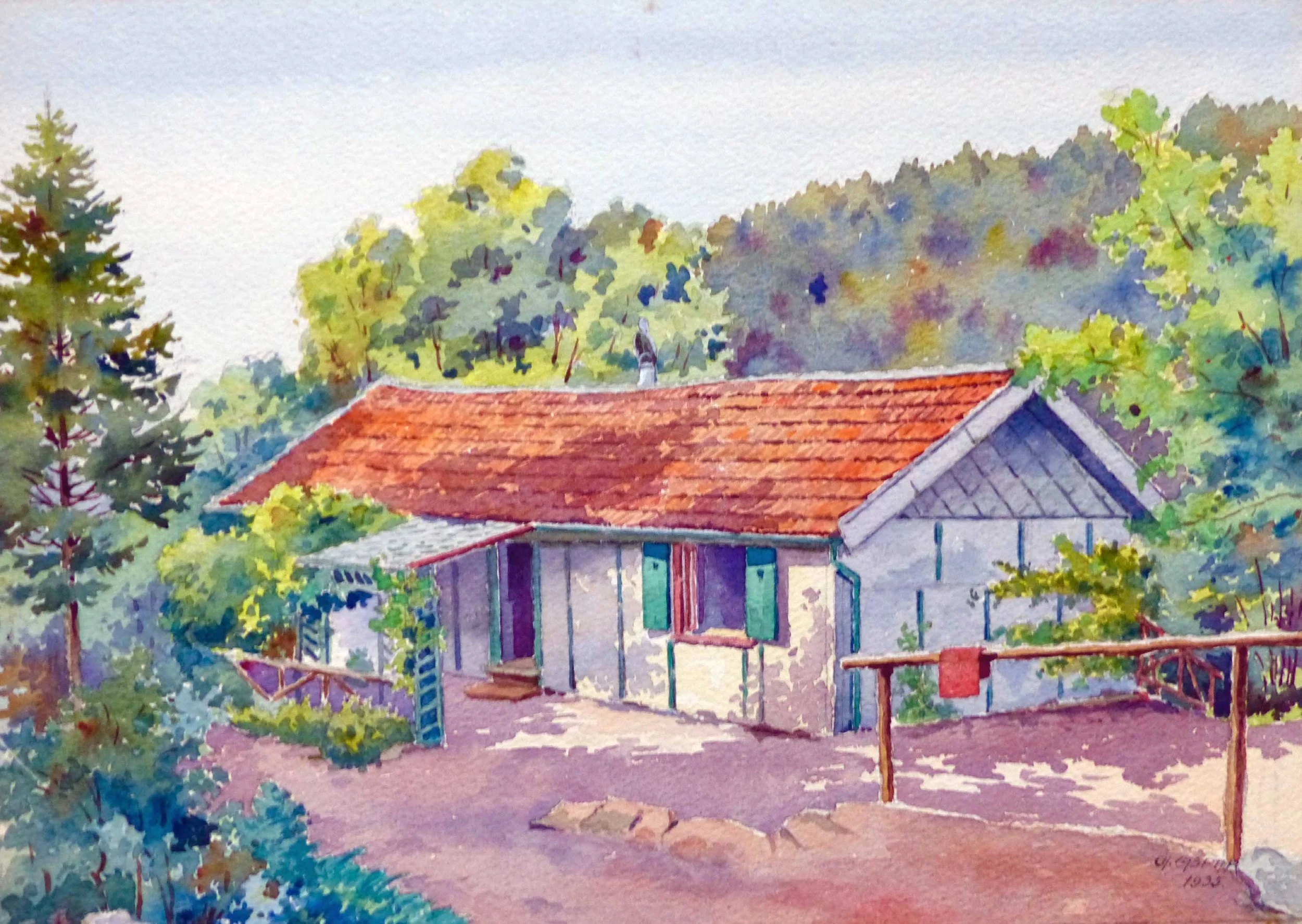
The first chalet, watercolour by Charles Caspar. 1935.
2008, seventeen years ahead
I launch Calkulator in 2008 without knowing that I'm carrying this legacy. The problem to solve: how can designers price their work fairly when they're selling a creative process that doesn't yet exist? No tangible object to show before starting, no established market price, designers often underestimate their value, clients contest quotes. A method is needed.
Calkulator becomes a pioneering pricing tool for design. Seventeen years later, in 2026: more than 11,000 designer users, mainly in France and French-speaking countries (Belgium, Luxembourg, Switzerland). A proven method.
Seventeen years demonstrating the value of the method. Today, in 2026, the market is catching up with our vision: designers are finally talking about valorisation, clients are seeking transparency. We have the experience that new entrants don't. Same pattern as Bachmatten: build before the market, educate, prove.
A defining event in 2020: the COVID-19 crisis. Lockdowns, the abrupt halt of the economy. The majority of independent designers and agencies see their revenues collapse. The crisis reveals a fragility: many struggle to defend the value of their work. The need for methodology becomes obvious.
The aftermath of the crisis accelerates market maturity. Post-COVID, European professional networks restructure, designers look for online tools to professionalise their practices, clients demand more transparency in quotes. It's in this context that Copryce® is born: not as a pioneer — that was Calkulator's role — but with a decisive competitive advantage. When the market matures, we already have 17 years of experience.
2025, Bachmatten finances Copryce®
2025, the chalets are sold. The decision to sell is unrelated to the existence of Copryce®. At 81, my father sees in my startup an extension of Bachmatten: serving creation. He invests this money — it is the first investment chronologically and the most symbolic. 97 years between construction and sale. Two world wars weathered. Four changes of border (Alsace German, French, German, French). The buildings survived the shell craters. Tangible proof of durability.
Charles built foundations from stones found on site, I'm building the bricks of a digital platform. Charles assembled boards with the firm Aloyse Frei and his 11 painter friends, I assemble modules with my partners Alain Frei (a namesake who bridges the eras), Axel Crété and Brigitte Borja de Mozota. Charles invested 1,000 francs in 1928, my father invests the Bachmatten money in 2025.
My father's investment in Copryce could be felt as pressure: the fear of failing. For me, it's the opposite — his trust strengthens mine. Building a startup is an accepted risk. It requires facing difficulties; nothing is guaranteed. His conviction strengthens my resolve. This isn't a toy being handed to me — I've been an entrepreneur for 35 years. This investment isn't sentimental, it's rational: my father sees the timing and the potential. Zoé Caspar, digital designer, is part of the team. Five generations now carry this approach. But Copryce is not a family affair — it's a startup that must succeed through its methodology and its product.
I'm now looking for partners. Same logic: community of trades, collective building, shared investment, long-term vision. The difference: the Cercle des Amateurs d'Art de Bachmatten built a physical retreat for 12 painters at weekends, we're building a digital platform for thousands of designers across Europe. But scale doesn't change the principle: you build something that must hold, serve and last.
2026: Copryce® arrives at the right moment
Copryce® is the evolution of Calkulator into a SaaS platform, soon to become an AI-powered mobile application. The refined methodology: co-construction between designers and clients. Our mission: to make the intangible value of design visible. The timing is right. We've been building for 17 years, designers are talking about valorisation, clients are looking for transparency tools. Alliance France Design (of which I am founding president) is structuring the profession. The EUIPO (European Union Intellectual Property Office) is taking an interest in design valorisation methodologies.
Brigitte Borja de Mozota becomes co-founder. A pioneer in her own right: design management researcher, author of the reference work Design Management, she has been theorising the ROI of design for decades. Where I built the practical tool, Brigitte built the academic research. Two complementary approaches that come together in Copryce. The methodology is refined: transparent co-construction between designers and clients. Our mission: Design Priced Right.
Copryce is born European and multilingual. French, Belgian, Luxembourg, Swiss, Spanish, Italian, German and Polish designers — among others — are looking for the same solutions. We're building a platform designed for Europe from the outset. Calkulator was a pioneer in France; Copryce arrives with the competitive advantage of a methodology proven over 17 years, at the moment when the European market demands it.
What can't be copied: every startup promises innovation, Copryce also promises durability. 17 years of methodological experience that new entrants will take 17 years to acquire. An international network of experts built over time. A demonstrated ability to anticipate the market and hold firm until it catches up with the vision.
We're looking for partners to accelerate Copryce's rollout: strengthening the SaaS infrastructure, developing the mobile application, growing the team, international deployment. Investors who, like the twelve painters of 1928, are ready to invest in a construction whose effects will unfold over time.
François Caspar, founder-CEO of Copryce
Why Copryce® · Team · Pioneers · Contact-us · Legal notices · Terms of use · Privacy policy · AI use